Electric Charge and Coulomb's Law: Understanding Forces Between Particles
By Sidra Tayyab · Education & Learning · 2025-12-08
Electric Charge and Coulomb's Law: Understanding Forces Between Charges
Every time you experience a static shock touching a doorknob, watch lightning split the sky, or use any electronic device, you're witnessing the effects of electric charge and the forces it generates. Electric charge is one of the most fundamental properties of matter, and the law governing the forces between charges — Coulomb's Law — is one of physics' most elegant and powerful equations. Understanding these concepts opens the door to understanding electricity, magnetism, and ultimately the entire field of electromagnetism.
1. What Is Electric Charge?
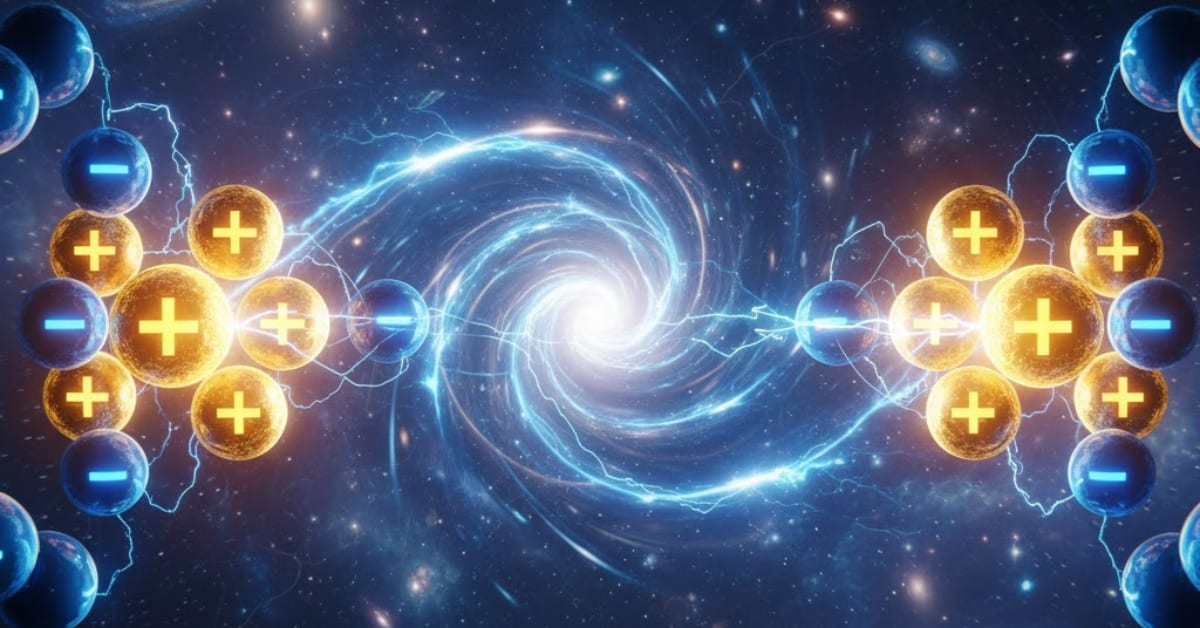
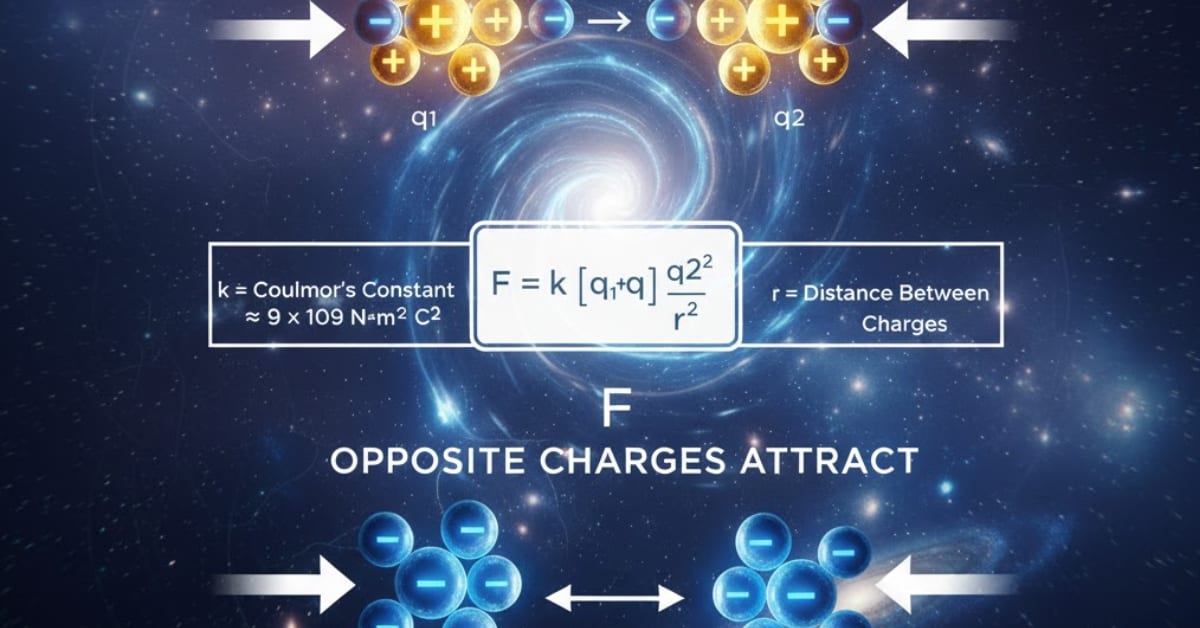
Electric charge is an intrinsic property of matter that causes it to experience electromagnetic force. There are two types of charge: positive and negative. Protons carry positive charge; electrons carry negative charge. Opposite charges attract each other; like charges repel. Most matter is electrically neutral because it contains equal numbers of protons and electrons. When this balance is disturbed — by friction, chemical reactions, or other mechanisms — a net charge develops and electromagnetic effects become apparent.
2. The Quantization of Charge
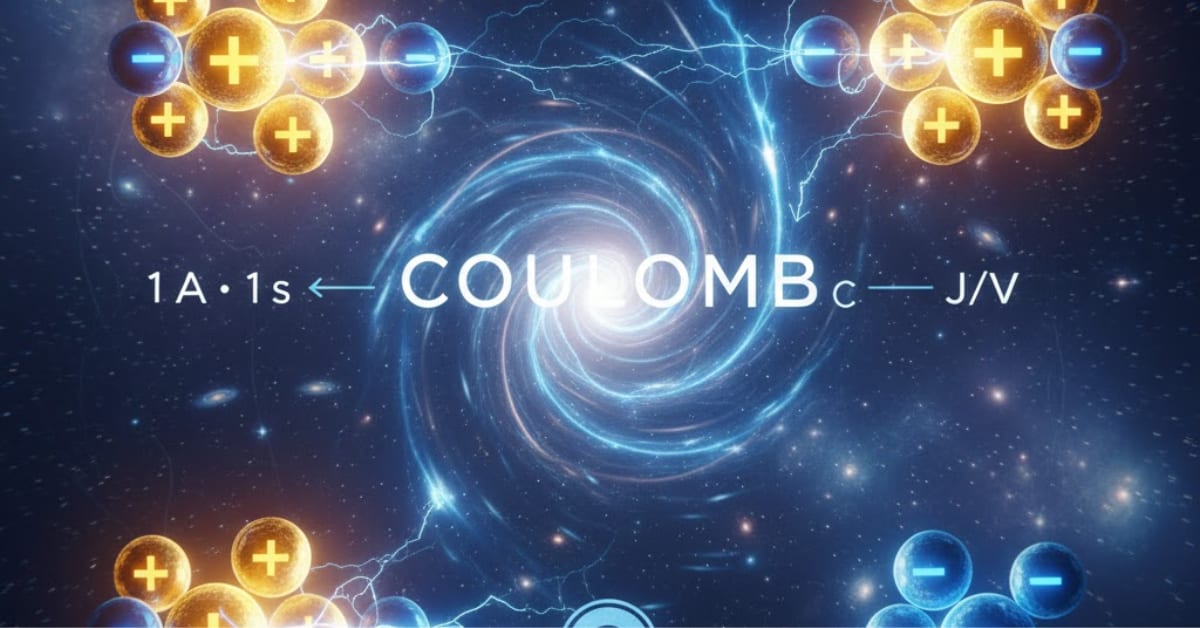
Electric charge comes in discrete units — it is quantized. The fundamental unit is the elementary charge (e), approximately 1.6 × 10⁻¹⁹ coulombs. Every observable charged particle has a charge that is a whole-number multiple of this elementary charge. Electrons carry one unit of negative charge (−e); protons carry one unit of positive charge (+e). This quantization means you can never have half an elementary charge — charge comes in indivisible packets, which reflects the fundamental discrete nature of matter at the quantum level.
3. Coulomb's Law: The Force Between Charges
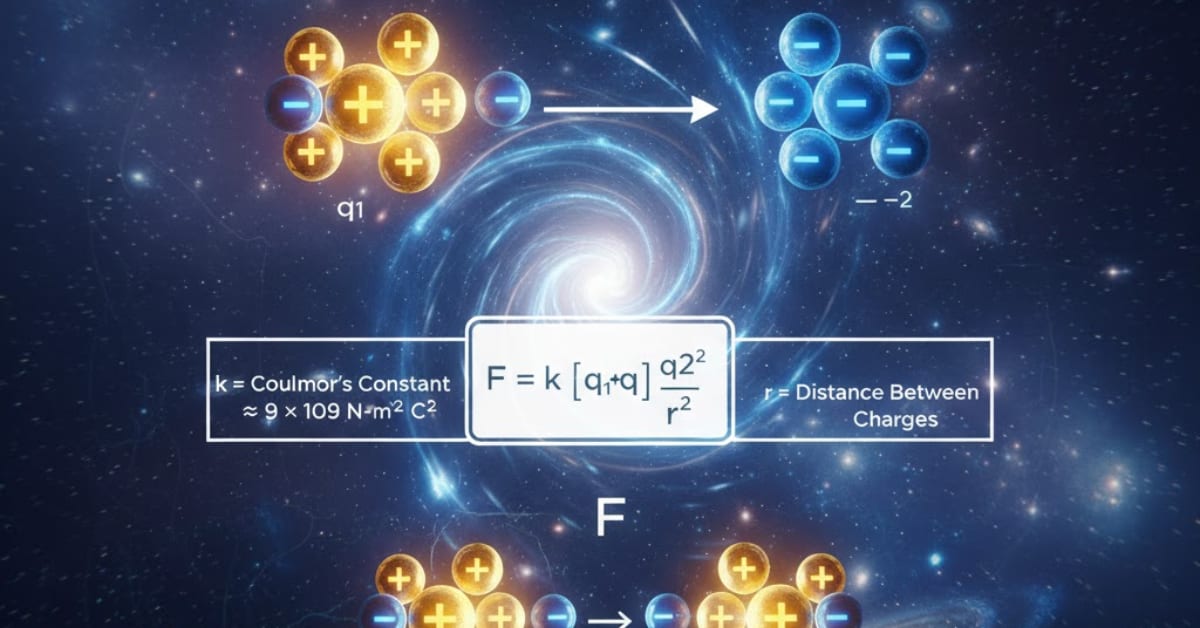
Charles-Augustin de Coulomb formulated his famous law in 1785, describing the force between two point charges. Coulomb's Law states that the electrostatic force between two charged objects is directly proportional to the product of their charges and inversely proportional to the square of the distance between them: F = k × (q₁ × q₂) / r². Here, k is Coulomb's constant (approximately 8.99 × 10⁹ N·m²/C²), q₁ and q₂ are the charges, and r is the separation distance. The force is attractive if the charges are opposite and repulsive if they're the same.
4. The Inverse Square Relationship
The inverse square relationship in Coulomb's Law — where force decreases with the square of distance — has a profound geometric explanation. The electrostatic force emanates outward from a charge in all directions equally, spreading over the surface of an expanding sphere. Since sphere surface area increases with the square of radius, the force per unit area (and per test charge placed on that sphere) decreases with the square of distance. This same inverse-square relationship appears in Newton's law of gravity — a deep mathematical symmetry between two of nature's fundamental forces.
5. The Electric Field
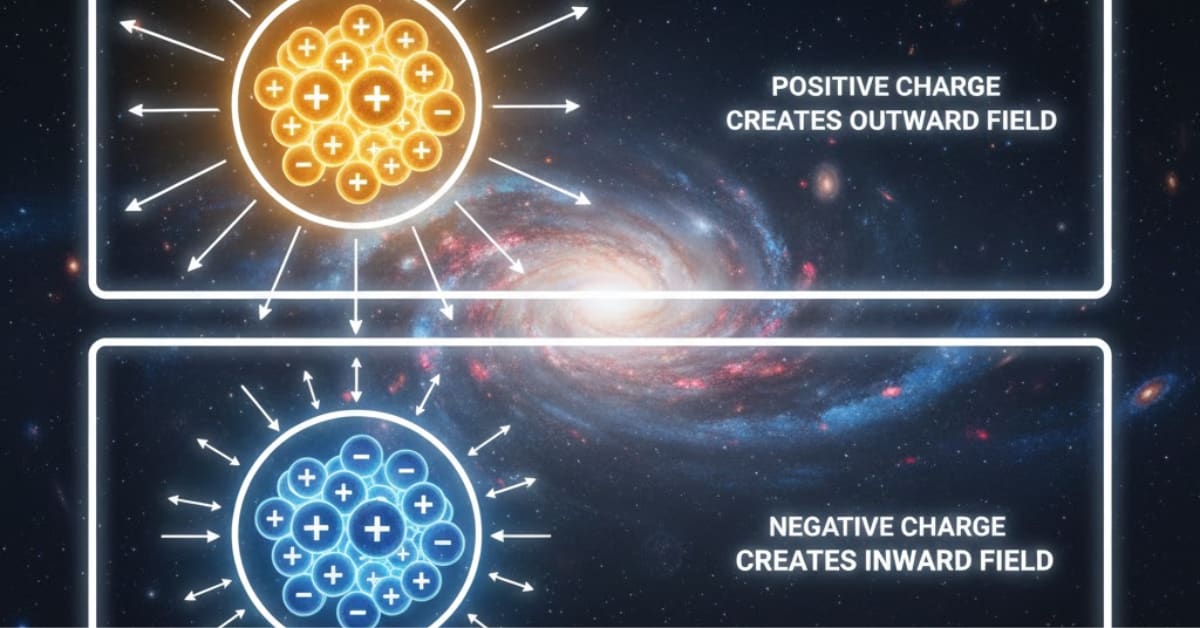
Rather than thinking about forces between pairs of charges directly, physicists find it useful to describe the electric field — a property of space that indicates how a positive test charge would be pushed or pulled at any given location. A positive charge creates an electric field that points outward in all directions; a negative charge creates a field that points inward. The concept of the electric field is not just a mathematical convenience — fields carry energy and momentum and are physically real entities that propagate through space at the speed of light.
6. Conductors and Insulators
Materials respond very differently to electric charge based on how freely electrons can move through them. Conductors — like metals — allow electrons to flow freely, so any excess charge quickly distributes itself across the surface and the interior becomes charge-free. Insulators — like rubber, glass, and plastic — hold electrons in place, allowing charges to remain localized. This difference is fundamental to all electrical engineering: conductors are used to carry current and insulators are used to confine it, directing electricity through circuits safely and efficiently.
7. Static Electricity and Everyday Applications
Static electricity occurs when charge builds up on an insulating material through friction (the triboelectric effect). When you shuffle across carpet and touch a metal doorknob, electrons transfer and you feel the discharge as a spark — a tiny lightning bolt. Industrial applications of static electricity include photocopiers and laser printers (which use charged drums to attract toner particles precisely), electrostatic paint spraying (which ensures even coating), and air purifiers (which use electric fields to attract and trap particles). Static electricity is far more useful than nuisance alone.
8. Coulomb's Law and the Structure of the Atom
Coulomb's Law governs the forces that hold atoms together. The negatively charged electrons in an atom are attracted to the positively charged protons in the nucleus — this electrostatic attraction is what keeps the electron "orbiting" (in the quantum mechanical sense) rather than flying away. The repulsion between protons in the nucleus is overcome by the strong nuclear force, a completely different interaction. Understanding the balance between Coulomb repulsion and nuclear attraction was essential to explaining atomic structure and nuclear physics.
9. From Coulomb to Maxwell: Building Electromagnetism
Coulomb's Law was just the beginning. Subsequent work by Gauss, Faraday, Ampère, and ultimately James Clerk Maxwell synthesized electrostatics, magnetism, and light into a unified framework: classical electromagnetism described by Maxwell's four equations. Maxwell showed that changing electric fields produce magnetic fields, and changing magnetic fields produce electric fields — and that this interplay propagates through space as electromagnetic waves at the speed of light. This revelation unified optics with electricity and magnetism in one of the greatest theoretical achievements in the history of science.
10. Practical Importance of Coulomb's Law
Coulomb's Law underpins technologies that shape modern life. The design of capacitors — components that store electric energy — relies on calculating the forces and fields between charged plates. Chemical bond formation is fundamentally a consequence of the electrostatic attraction between nuclei and electrons. DNA's double helix structure is maintained partly through electrostatic interactions. Medical imaging technologies like MRI depend on electromagnetic principles derived from the same foundations as Coulomb's Law. In short, the force between two charges described by an 18th-century physicist remains as relevant and practically important as ever.
Electric charge and Coulomb's Law represent the foundation on which all of electrical and electronic technology is built. From the spark of static electricity to the flow of current through a circuit to the electromagnetic waves carrying your WiFi signal, every aspect of our electrically powered civilization traces back to the fundamental property of charge and the elegant inverse-square force law that governs how charges interact. Understanding these foundations is understanding the invisible architecture of the modern world.
01. What is electric charge?
02. Units of electric charge
03. Law of conservation of charge (conservation of charge)
04. What is Coulomb's Law?
05. Direction of force
06. Coulomb’s Law Examples in Real Life

07. Relationship to electric fields