Entropy: Understanding Disorder and Energy in Physical Systems
By Sidra Tayyab · Education & Learning · 2025-12-03
Entropy: Understanding Disorder and Energy in Physical Systems
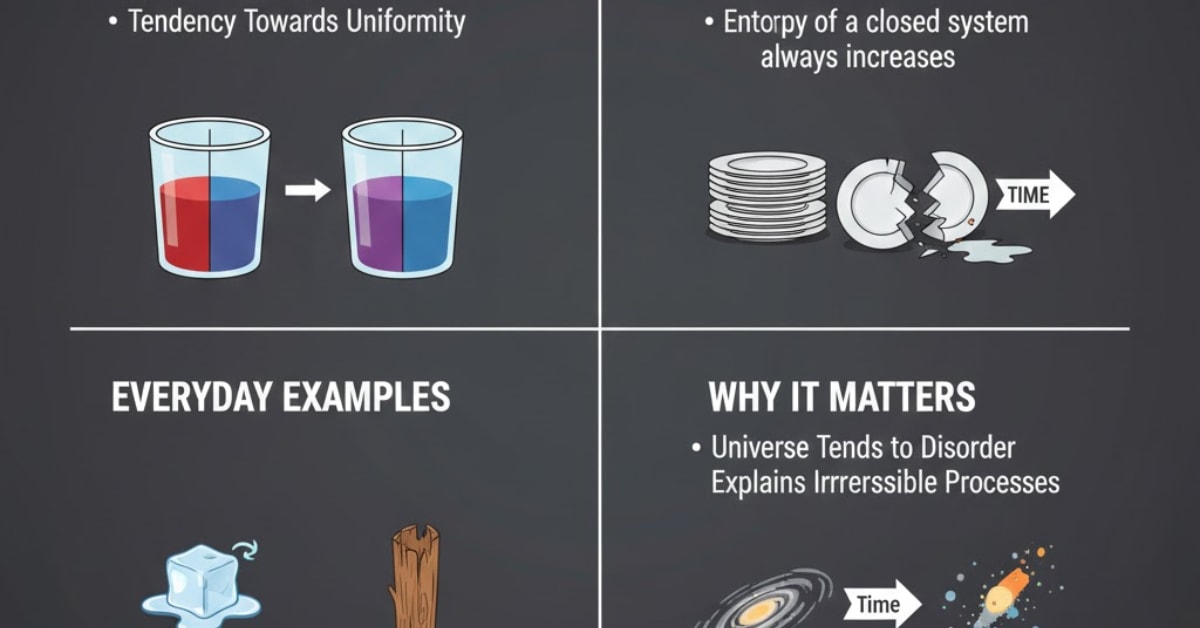
Why does ice always melt into water, but water never spontaneously freezes into ice unless cooled? Why does a drop of ink spread through a glass of water but never gather back together? Why does everything seem to naturally move from order toward disorder? The answer to all these questions is entropy — one of the most profound and far-reaching concepts in all of science.
1. What Is Entropy?
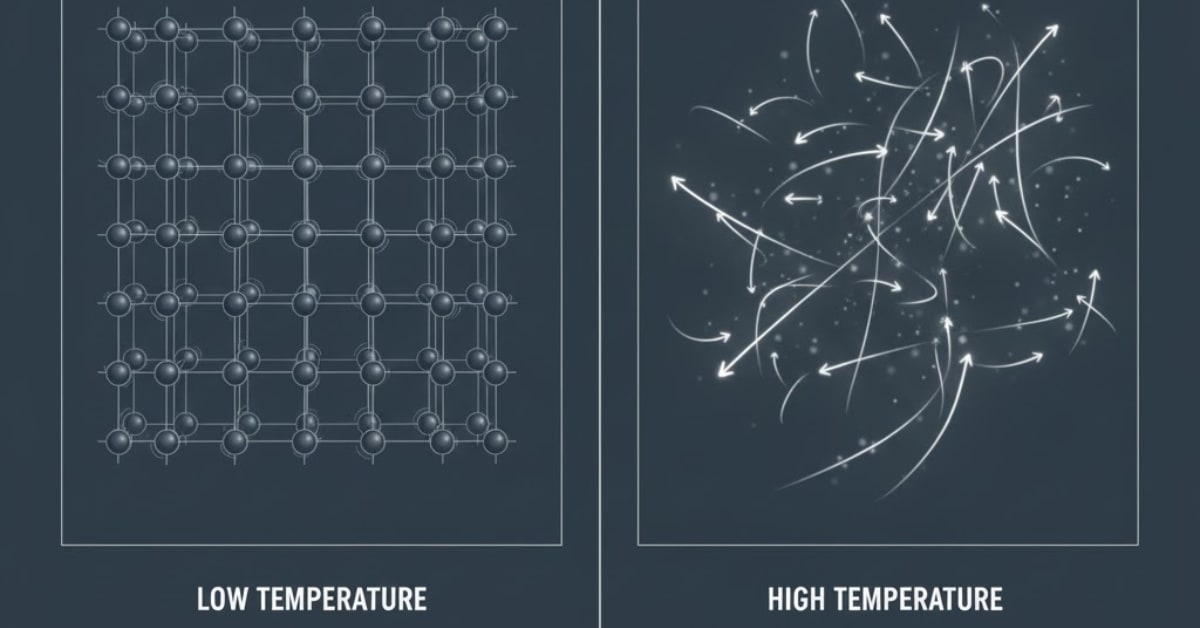
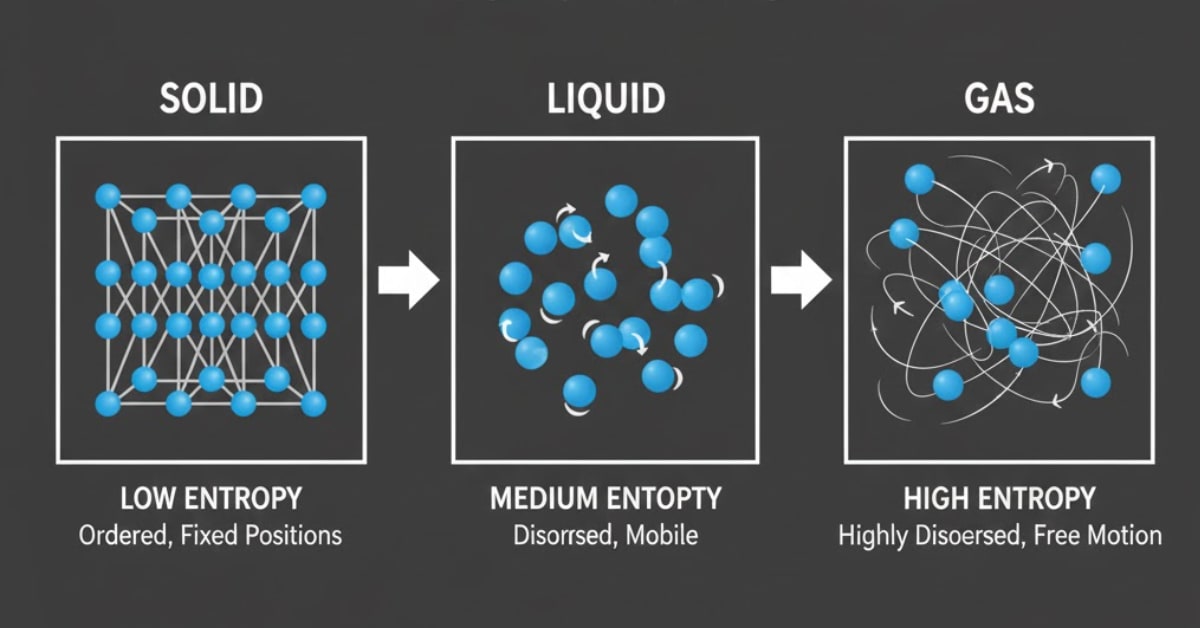
Entropy is a measure of the number of ways the microscopic components of a system can be arranged while still producing the same macroscopic state. In simpler terms, it's a measure of disorder or randomness. A crystal has low entropy — its atoms are arranged in a precise, ordered pattern with very few equivalent arrangements. A gas has high entropy — its molecules are spread throughout a container in countless possible arrangements. Nature, driven by probability, overwhelmingly favors the high-entropy state.
2. The Second Law of Thermodynamics
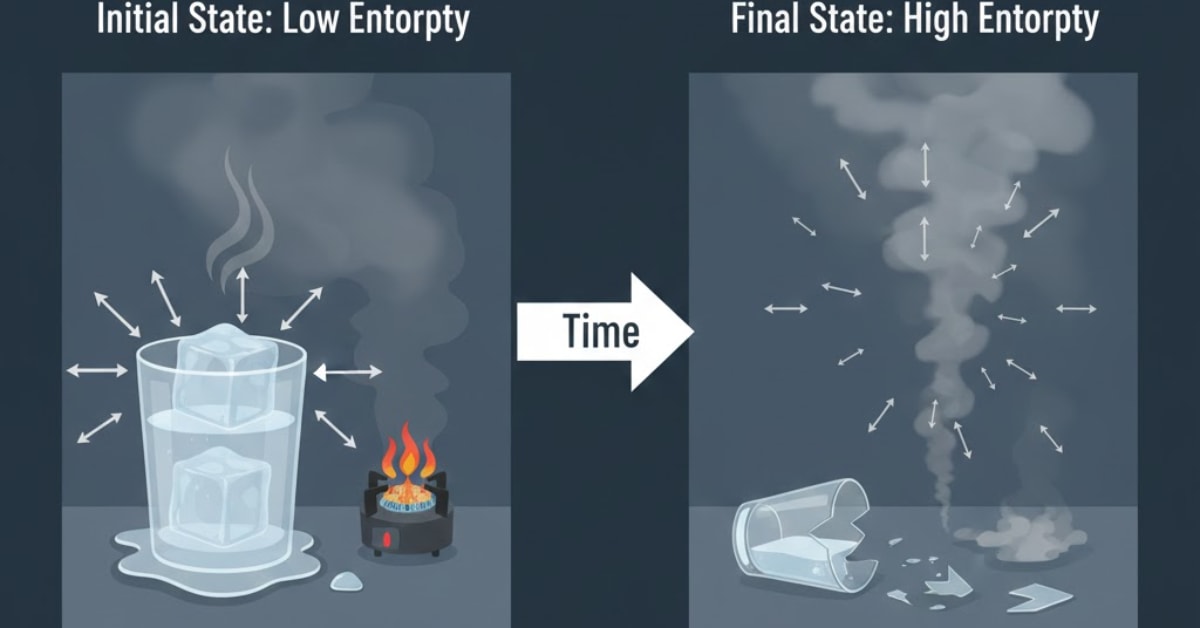
The Second Law of Thermodynamics states that the total entropy of an isolated system always increases over time — it never decreases spontaneously. This law is unique among physical laws in that it gives time a direction. Most physical laws work equally well forward and backward in time — a video of billiard balls colliding looks plausible whether played forward or backward. But a video of an ice cube melting cannot be run in reverse without appearing obviously absurd. Entropy's increase is what gives time its arrow.
3. Entropy and Probability
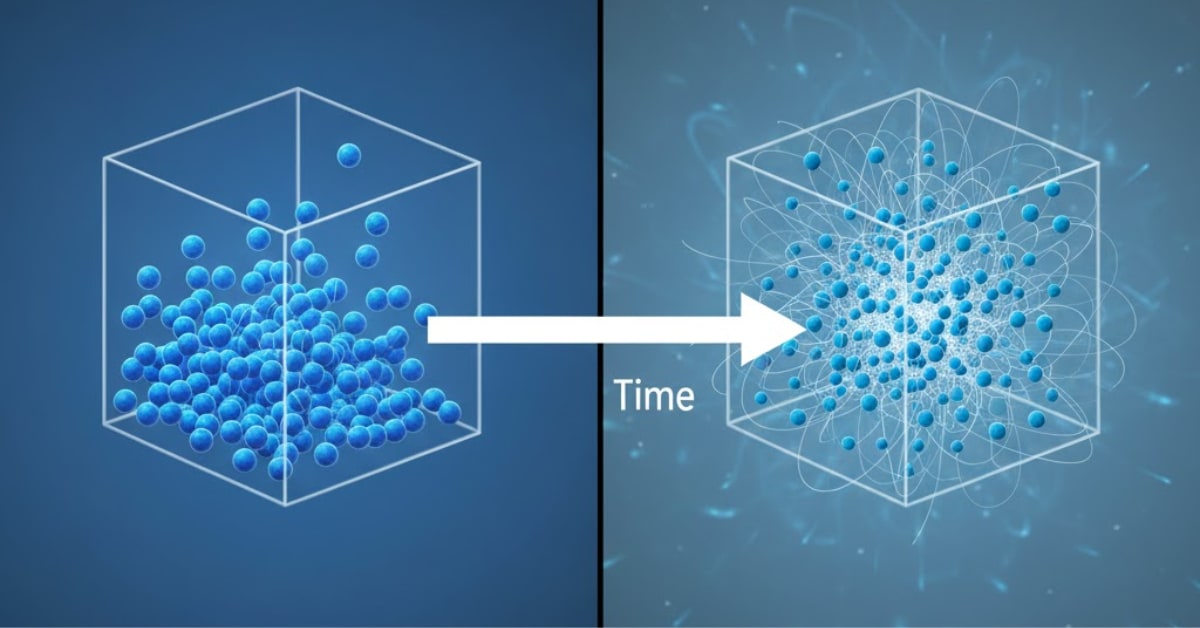
The deep reason entropy increases is fundamentally probabilistic. Consider 100 gas molecules in a box. The probability that all 100 molecules spontaneously crowd into one corner is astronomically small compared to the probability that they spread evenly. There is only one "all in one corner" state but an enormous number of "evenly distributed" states. Physical systems explore all accessible states randomly, so they overwhelmingly tend toward the states with the most arrangements — the high-entropy states. Entropy isn't a mysterious force; it's just statistics at work.
4. Ludwig Boltzmann's Revolutionary Formula
Austrian physicist Ludwig Boltzmann provided the mathematical foundation for entropy in the 1870s with his famous equation: S = k × ln(W), where S is entropy, k is Boltzmann's constant, and W is the number of microstates corresponding to the macroscopic state. This equation — inscribed on Boltzmann's tombstone in Vienna — connected the macroscopic concept of entropy with the microscopic world of molecules for the first time. It was one of the most elegant contributions in the history of physics.
5. Entropy in Everyday Life
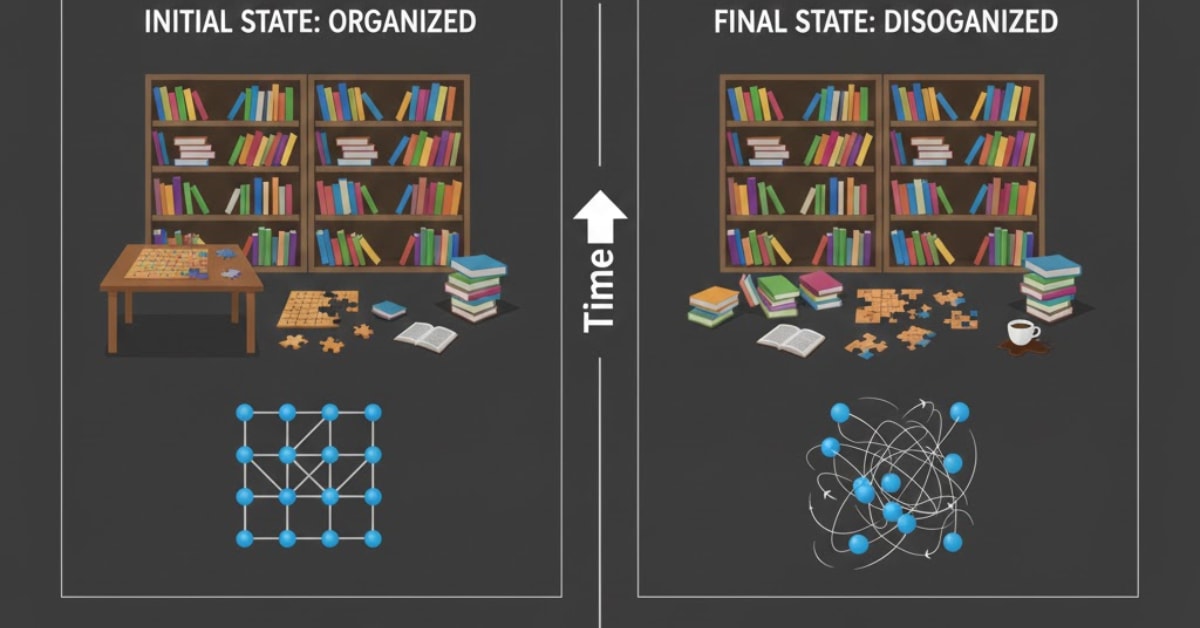
Entropy is everywhere once you know to look for it. A tidy room naturally becomes messy over time — there are many more "messy" configurations of objects than "tidy" ones. Perfume molecules released from a bottle spread throughout a room and never re-concentrate in the bottle. Heat flows from hot objects to cold ones, never the other way. The aging process itself is partly an entropic phenomenon — the ordered biological structures that maintain life gradually accumulate damage and disorder over time.
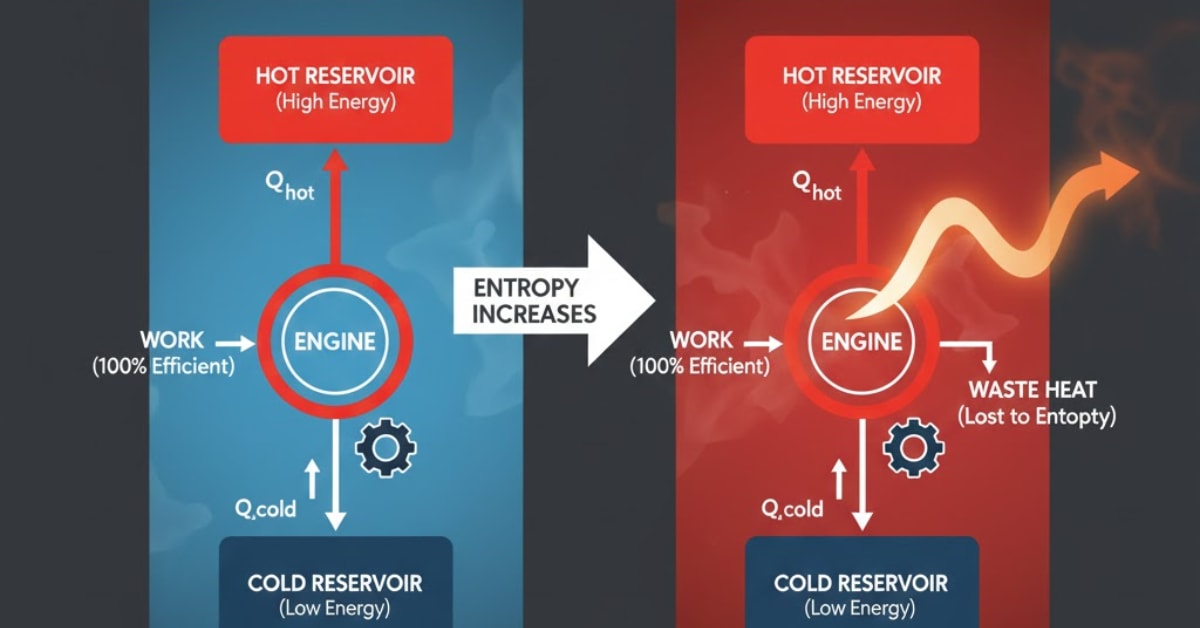
6. Entropy and Heat Engines
Understanding entropy transformed engineering in the 19th century. Steam engines work by exploiting temperature differences to do work, and entropy determines the fundamental limits of their efficiency. The Carnot efficiency theorem — derived from thermodynamic principles — shows that no heat engine can convert all the heat input into work; some must always be rejected as waste heat that increases entropy. This is why no engine is 100% efficient, and why improving engine efficiency always has physical limits regardless of engineering skill.
7. Entropy and Information Theory
In a stunning intellectual leap, mathematician Claude Shannon showed in 1948 that information has entropy too. The information entropy of a message measures its unpredictability — a highly predictable message (like "AAAAAAA") carries little information, while a random sequence carries maximum information entropy. Shannon's equations are mathematically identical in form to Boltzmann's thermodynamic entropy formula. This deep connection between physical disorder and information theory has profound implications for computing, data compression, cryptography, and our understanding of what information fundamentally is.
8. Can Entropy Be Reversed?
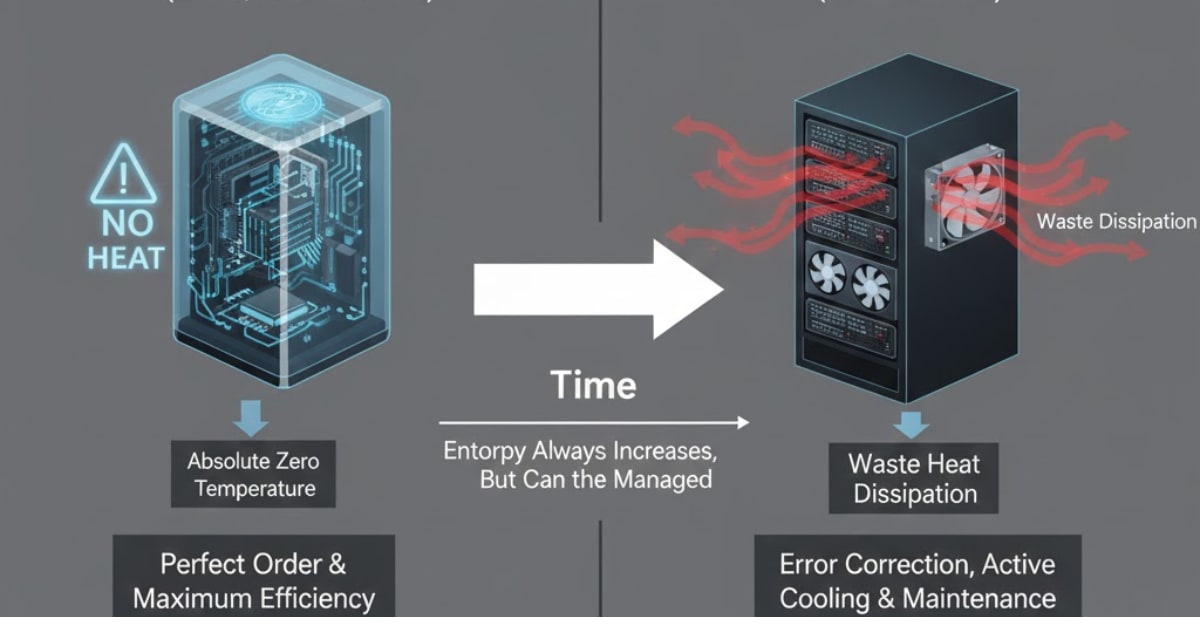
Locally, yes — entropy can decrease in a subsystem, but only by increasing it elsewhere. Refrigerators make their interiors cold (lower entropy) by expelling heat to the room (higher entropy). Living organisms maintain their highly ordered internal structures by consuming food and releasing heat and waste — dramatically increasing entropy in their surroundings. The universe as a whole obeys the Second Law strictly — entropy always increases globally, even when local pockets of order emerge.
9. The Heat Death of the Universe
Following entropy to its logical conclusion leads to the concept of the "heat death" of the universe — a state of maximum entropy where all temperature differences have equalized, all usable energy has been dissipated as waste heat, and no more work can ever be done. This ultimate equilibrium state, predicted by thermodynamics, represents the ultimate fate of a closed universe. It's a sobering idea, but also an extraordinarily distant one — the universe has trillions upon trillions of years before approaching this state.
10. Why Entropy Is Beautiful
Entropy is beautiful not despite being about disorder, but because of it. It explains the directionality of time, the ultimate fate of the universe, the limits of all engines and computers, and the very nature of information — all from a single, elegant statistical principle. It reveals that the "arrow of time" is not a fundamental feature of physical law but an emergent consequence of probability. In entropy, physics shows us that randomness and probability are not just mathematical tools but the deepest engine driving all of nature.
Entropy touches everything — from the ice melting in your drink to the long-term fate of the cosmos. Understanding it means understanding one of the fundamental principles by which the universe operates. And there's something strangely beautiful about knowing that nature's tendency toward disorder is not chaos but the inevitable expression of mathematical probability on an astronomical scale.
01. What is entropy?

02. Energy and Entropy

03. Gas molecules and entropy
04. Second law of thermodynamics
05. Entropy and temperature
06. Entropy and energy efficiency
07. Treatment of entropy
08. Entropy and Phase Changes
09. Entropy and the Disorganization of a System
10. Introduction to Entropy