How does the kinetic theory of gases explain the behavior of gases?
By Sidra Tayyab · Education & Learning · 2025-11-27
How the Kinetic Theory of Gases Explains Their Behavior
Why does a balloon expand when you heat it? Why does pressure increase when you pump more air into a tire? Why do gases fill whatever container they occupy? The kinetic theory of gases answers all these questions — and it does so with a beautifully simple set of assumptions about the microscopic behavior of molecules that accurately predicts the macroscopic properties of gases we observe every day.
1. What Is the Kinetic Theory of Gases?
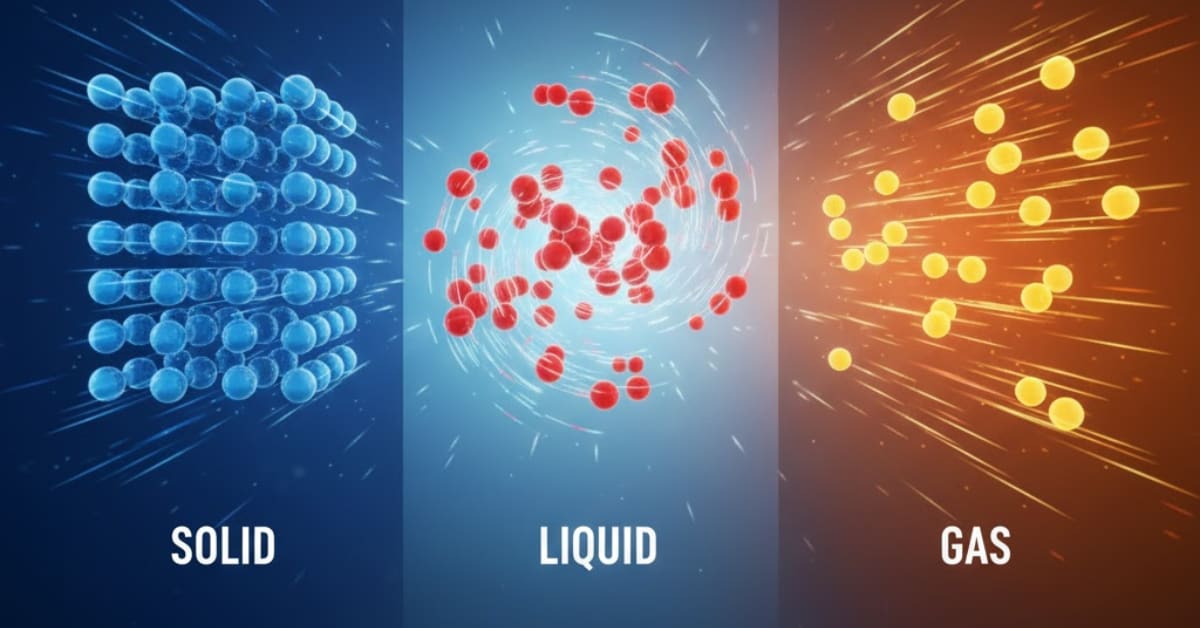
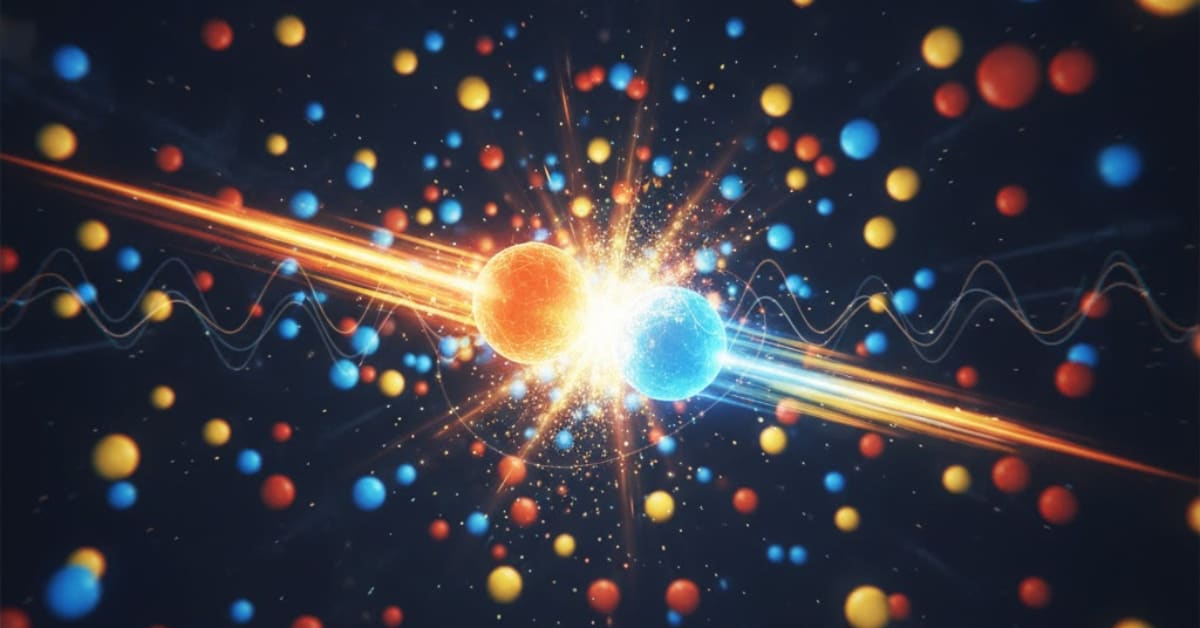
The kinetic theory of gases is a model that describes the behavior of gases in terms of the motion of their constituent molecules. Developed through the 19th century by scientists including Rudolf Clausius, James Clerk Maxwell, and Ludwig Boltzmann, it assumes that: (1) gases consist of a large number of molecules in constant, random motion; (2) gas molecules are very small compared to the distances between them; (3) molecular collisions are perfectly elastic (no kinetic energy lost); (4) the average kinetic energy of the molecules is proportional to absolute temperature; and (5) there are no forces between molecules except during brief collisions.
2. Gas Pressure Explained
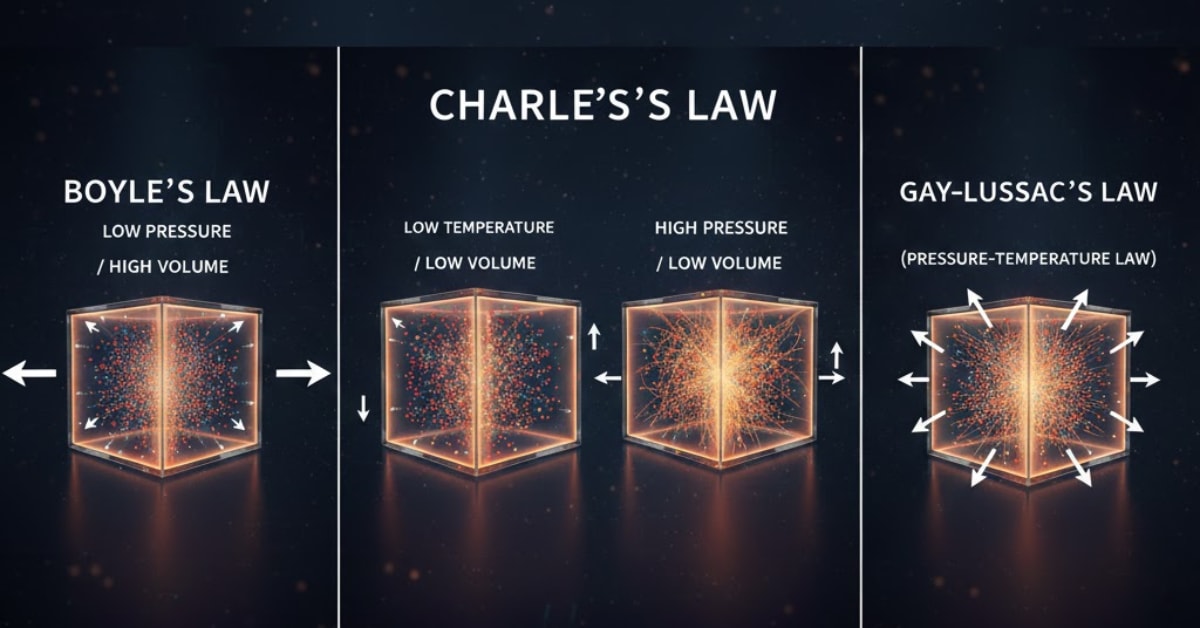
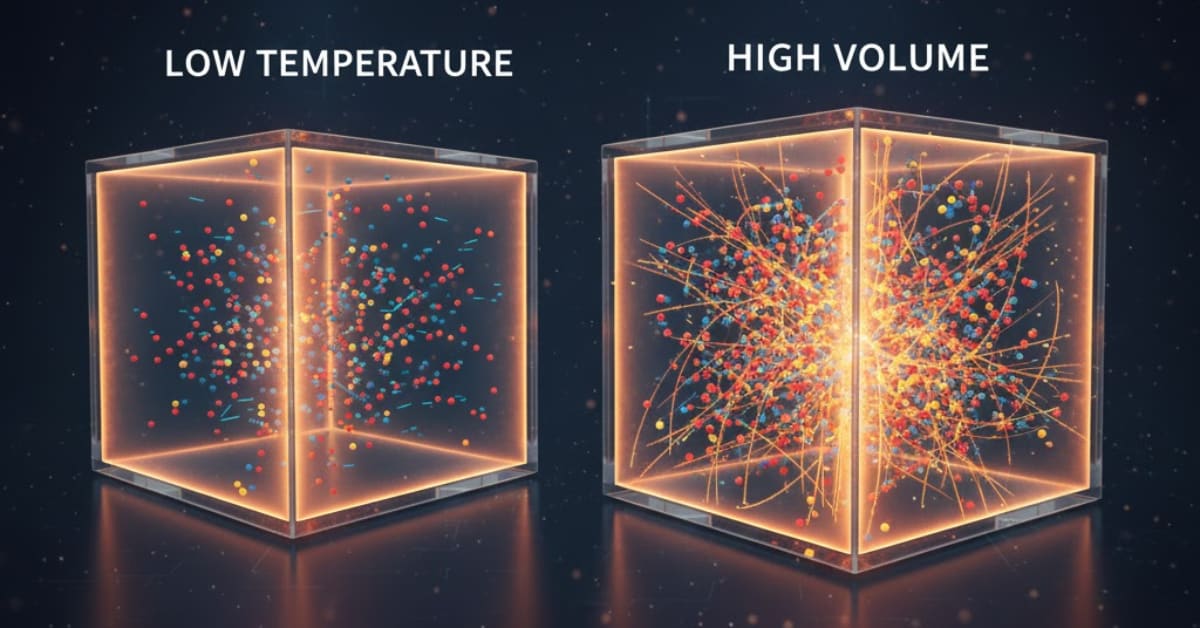
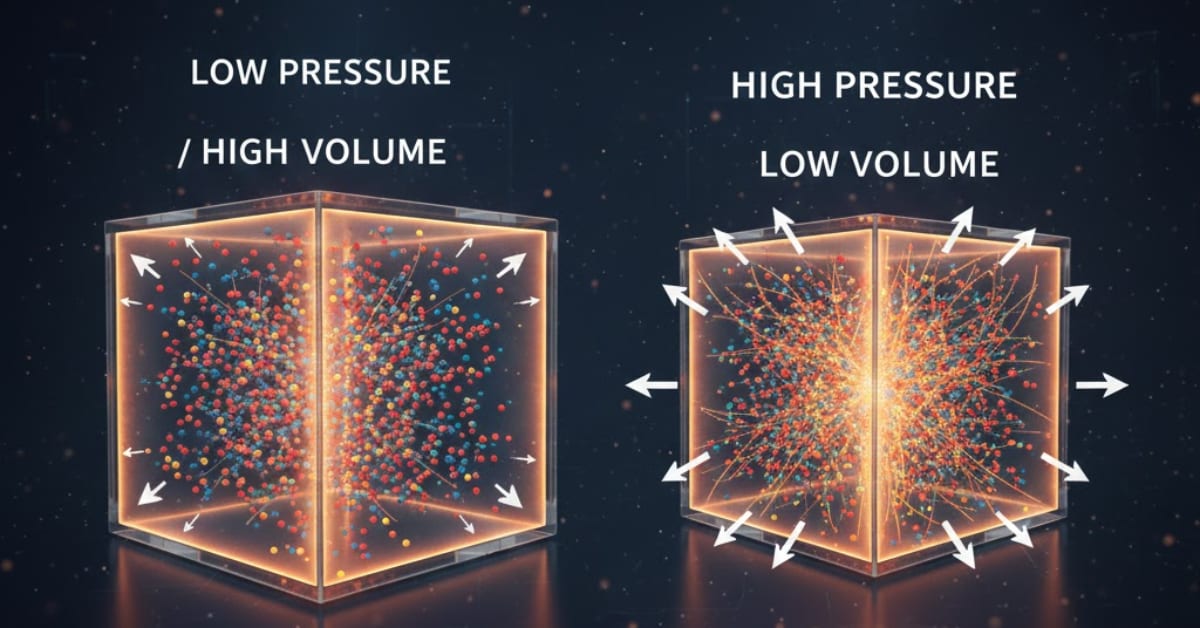
Pressure is one of the most fundamental properties of a gas, and the kinetic theory explains it beautifully. When gas molecules move randomly and collide with the walls of a container, each collision exerts a tiny force on the wall. Gas pressure is simply the cumulative effect of billions of these collisions per second on every square meter of container wall. More molecules in the same volume means more collisions per second and therefore higher pressure. Hotter molecules move faster, hit walls harder and more frequently, and also produce higher pressure. This explains Boyle's Law and Gay-Lussac's Law from first principles.
3. Temperature as Molecular Motion
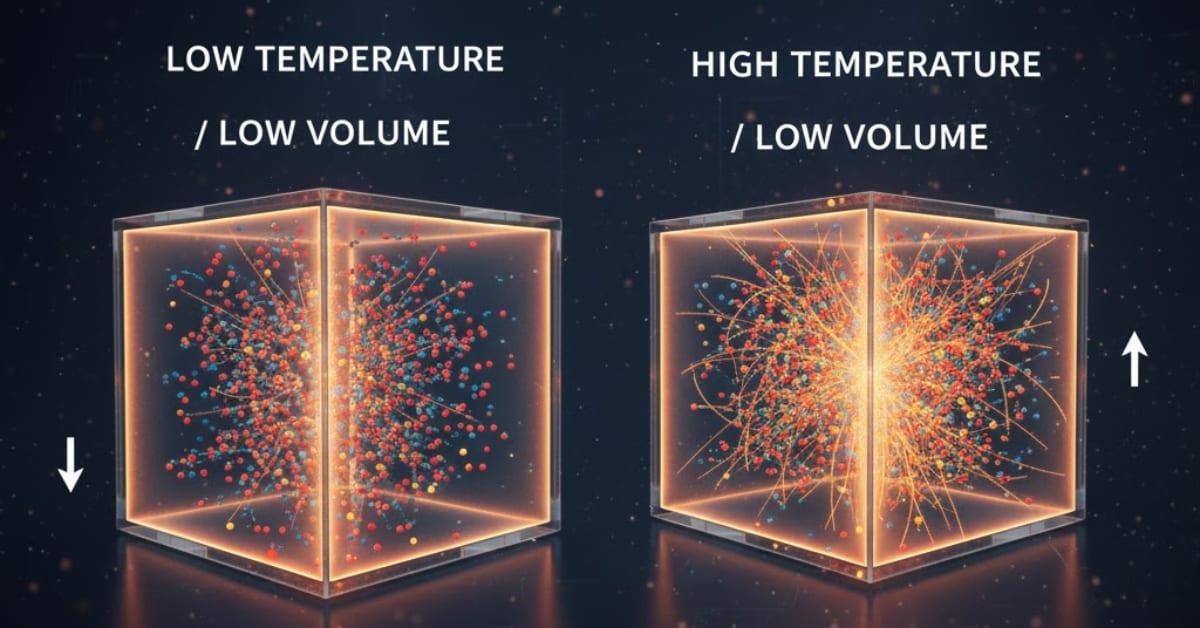
The kinetic theory provides a profound physical meaning for temperature: it is a measure of the average kinetic energy of molecules in a substance. A "hot" gas is simply one whose molecules are moving, on average, faster than the molecules of a "cold" gas. This is not just a metaphor — temperature and molecular kinetic energy are mathematically related: average kinetic energy = (3/2)kT, where k is Boltzmann's constant and T is absolute temperature. At absolute zero (0 Kelvin), molecular motion would theoretically cease entirely, representing the lowest possible temperature.
4. The Maxwell-Boltzmann Distribution
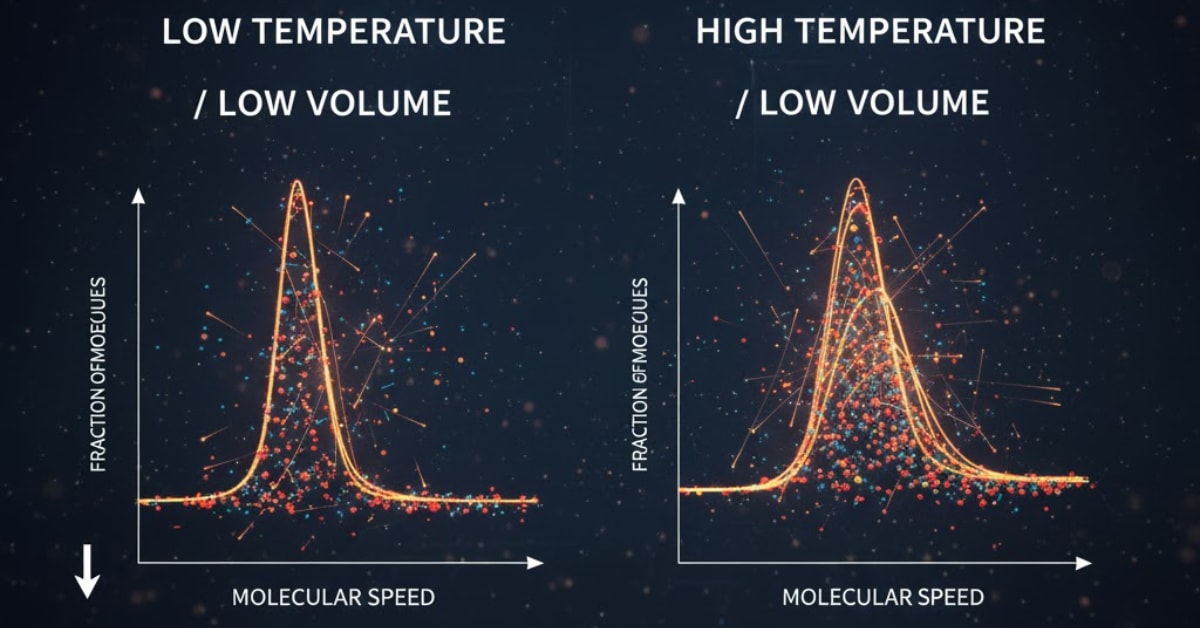
Not all molecules in a gas move at the same speed — there is a statistical distribution of speeds. James Clerk Maxwell and Ludwig Boltzmann derived the mathematical distribution of molecular speeds in a gas at a given temperature, now called the Maxwell-Boltzmann distribution. This bell-shaped curve shows that most molecules move near the most probable speed, with some moving much slower and some much faster. The shape of this distribution changes with temperature: higher temperatures produce broader distributions with higher average speeds. This distribution has practical consequences for chemistry — chemical reactions require molecules to collide with sufficient energy to react.
5. Diffusion and Effusion
Diffusion — the gradual mixing of one gas into another — is a direct consequence of the random molecular motion described by the kinetic theory. When you open a bottle of perfume in a room, the perfume molecules begin randomly moving in all directions and gradually spread throughout the space. Graham's Law of Diffusion (and Effusion) states that the rate at which a gas diffuses is inversely proportional to the square root of its molar mass — lighter molecules diffuse faster. This law was derived from kinetic theory and has practical applications ranging from uranium isotope separation to the design of gas masks.
6. The Ideal Gas Law
The Ideal Gas Law — PV = nRT — is the practical result of combining the kinetic theory's predictions. It relates pressure (P), volume (V), amount of gas in moles (n), the gas constant (R), and absolute temperature (T). This single equation accurately describes the behavior of most gases under ordinary conditions and is used in chemistry, physics, engineering, and atmospheric science every day. It explains why car tire pressure increases on a hot summer day, why aerosol cans carry warnings about heat exposure, and how scuba divers must account for pressure changes when ascending.
7. Real Gases vs. Ideal Gases
The kinetic theory makes simplifying assumptions — particularly that gas molecules have no volume and no intermolecular forces. In reality, at high pressures (where molecules are crowded closer together) and low temperatures (where they move slowly enough for forces to matter), these assumptions break down and gases deviate from ideal behavior. The van der Waals equation corrects for these deviations by adding terms for molecular volume and intermolecular attraction. These corrections are critical in industrial applications involving compressed gases, liquefaction, and supercritical fluids.
8. Applications in the Real World
The kinetic theory of gases has enormous practical importance. Internal combustion engines work by combusting fuel to rapidly heat gas, which expands against pistons — directly applying the relationship between temperature, pressure, and volume from kinetic theory. Refrigeration cycles exploit the behavior of refrigerant gases under pressure and temperature changes described by kinetic theory. Weather forecasting requires understanding atmospheric gas behavior. Anesthesia dosing in medicine depends on understanding how gases behave and distribute at body temperature and blood pressure conditions.
9. Kinetic Theory and Thermodynamics
The kinetic theory provided the microscopic foundation for the macroscopic science of thermodynamics. Boltzmann's H-theorem showed, from kinetic theory, why entropy increases — why gas molecules that start in one corner of a container always spread throughout it rather than spontaneously gathering back together. This was a profound achievement: deriving the Second Law of Thermodynamics — previously an empirical observation — from the statistical mechanics of molecular collisions. It connected temperature, entropy, and irreversibility to molecular reality for the first time.
10. Why the Kinetic Theory Is Beautiful
The kinetic theory of gases is a triumph of scientific reasoning: from a few simple, plausible assumptions about invisible molecules too small to see, it derives accurate predictions about measurable bulk properties like pressure, temperature, volume, and diffusion rates. It shows that the "random chaos" of molecular motion is not truly random at all — it follows precise statistical laws that produce the ordered, predictable macroscopic behavior of gases. In doing so, it bridged the gap between the microscopic atomic world and the everyday macroscopic world we can observe and measure, representing one of the great intellectual achievements of 19th-century physics.
The kinetic theory of gases transforms abstract numbers on thermometers and pressure gauges into a vivid picture of molecular reality: billions of invisible spheres flying, bouncing, and colliding in perpetual, energetic motion. Understanding this picture doesn't just explain gases — it connects the visible, tangible world to the invisible one from which it emerges, and reveals the deep statistical order that underlies what appears to be pure chaos.
01. Motion of molecules
02. Random motion

03. Collisions and energy exchange
04. Pressure of a gas

05. Volume of a gas

06. Temperature and energy
07. Explanation of Boyle’s Law
08. Explain Charles’s Law
09. Distribution of energy of a gas
10. Presentation of gas behavior