Rotational Motion: The Science Behind Rotating Objects
By Sidra Tayyab · Education & Learning · 2025-11-10
Rotational Motion: The Science Behind Rotating Objects
Every spinning top, every rotating planet, every turning wheel, every figure skater pulling in their arms — all are governed by the physics of rotational motion. Rotational mechanics is the counterpart to linear mechanics, describing how objects rotate, spin, and revolve rather than move in straight lines. Understanding it reveals the elegant mathematical structure beneath familiar phenomena and enables the engineering of everything from wind turbines to gyroscopic navigation systems.
1. What Is Rotational Motion?
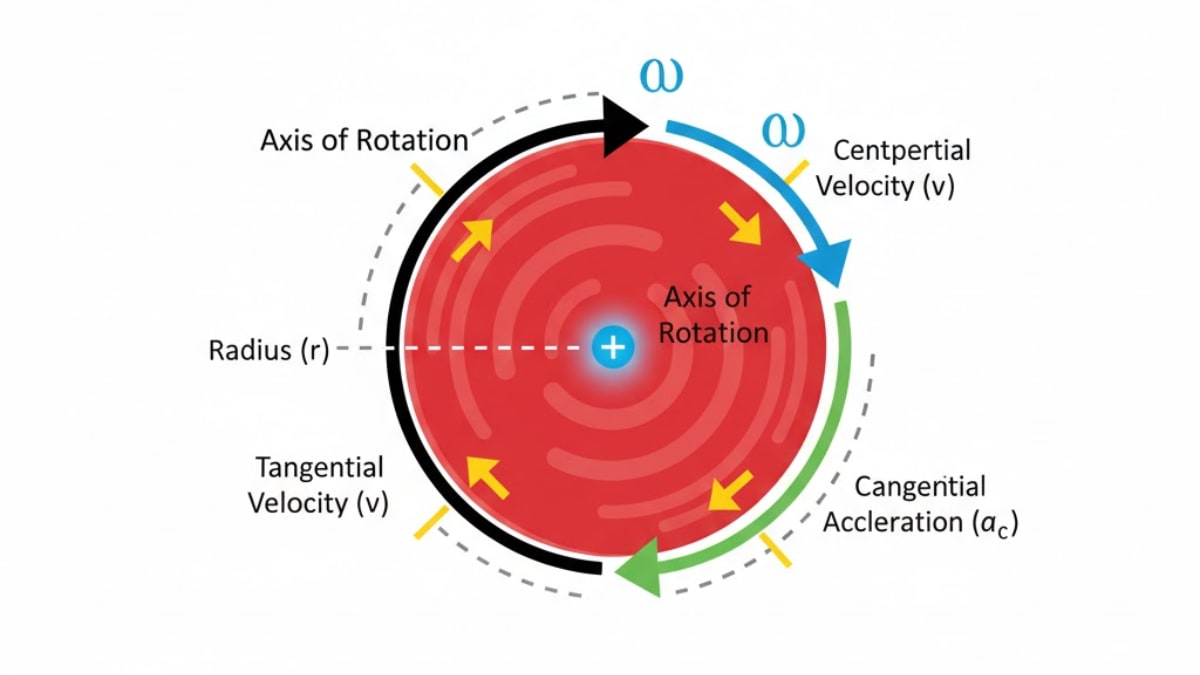
Rotational motion occurs when an object spins around an axis — a fixed line that the object rotates about. Unlike linear motion, where a single set of coordinates describes an object's position, rotational motion requires specifying the angle of rotation, the axis of rotation, and the direction of spin. Every point on a rotating object moves in a circle around the axis, and points farther from the axis travel faster (larger circumference for the same angle). This is why the tip of a spinning propeller moves much faster than its base.
2. Angular Displacement, Velocity, and Acceleration
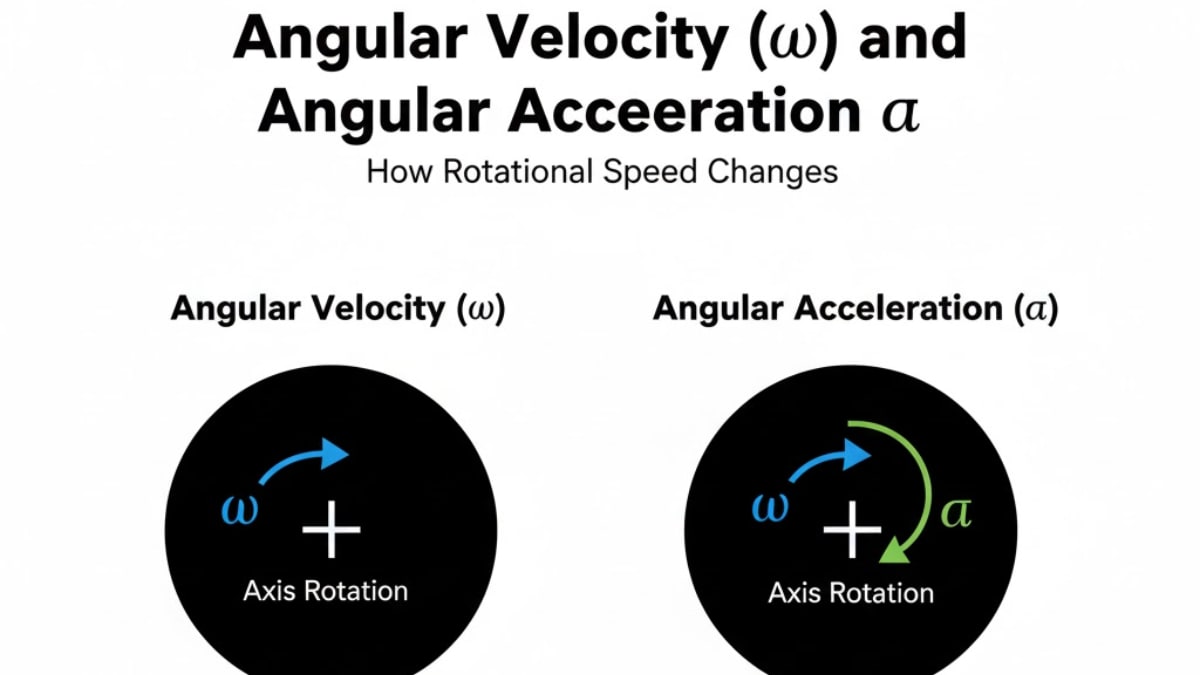
Rotational motion has exact analogues of the linear quantities position, velocity, and acceleration. Angular displacement (θ) measures how far an object has rotated, in radians. Angular velocity (ω) measures how fast it's rotating — how many radians per second. Angular acceleration (α) measures how quickly the angular velocity is changing. The equations of rotational kinematics are structurally identical to linear kinematics, with each linear quantity replaced by its rotational counterpart, making the mathematical structure of both domains beautifully symmetric.
3. Torque: The Rotational Equivalent of Force
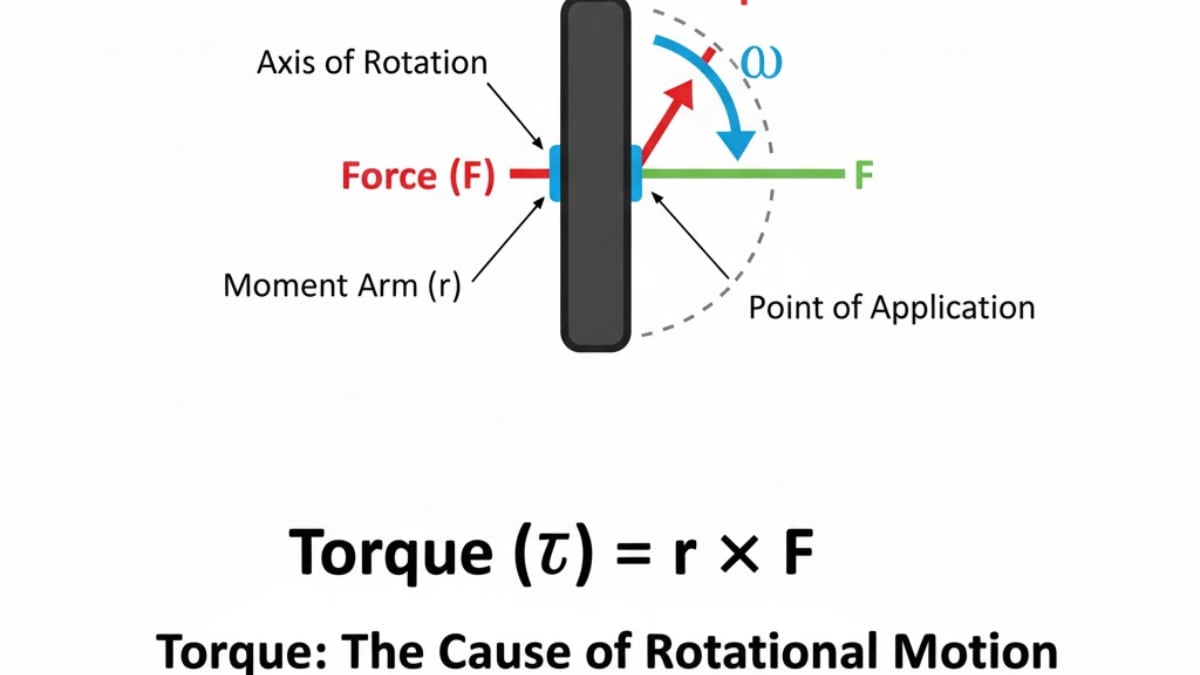
Just as force causes linear acceleration, torque causes angular acceleration. Torque (τ) is the tendency of a force to rotate an object about an axis, and it depends on both the magnitude of the force and its distance from the axis (the lever arm): τ = F × r × sin(θ). A door provides a simple demonstration: the same force applied at the edge of the door (large lever arm) produces much more torque — and much easier opening — than the same force applied near the hinge (small lever arm). This is why door handles are placed at the edge rather than the center.
4. Moment of Inertia: Rotational Mass
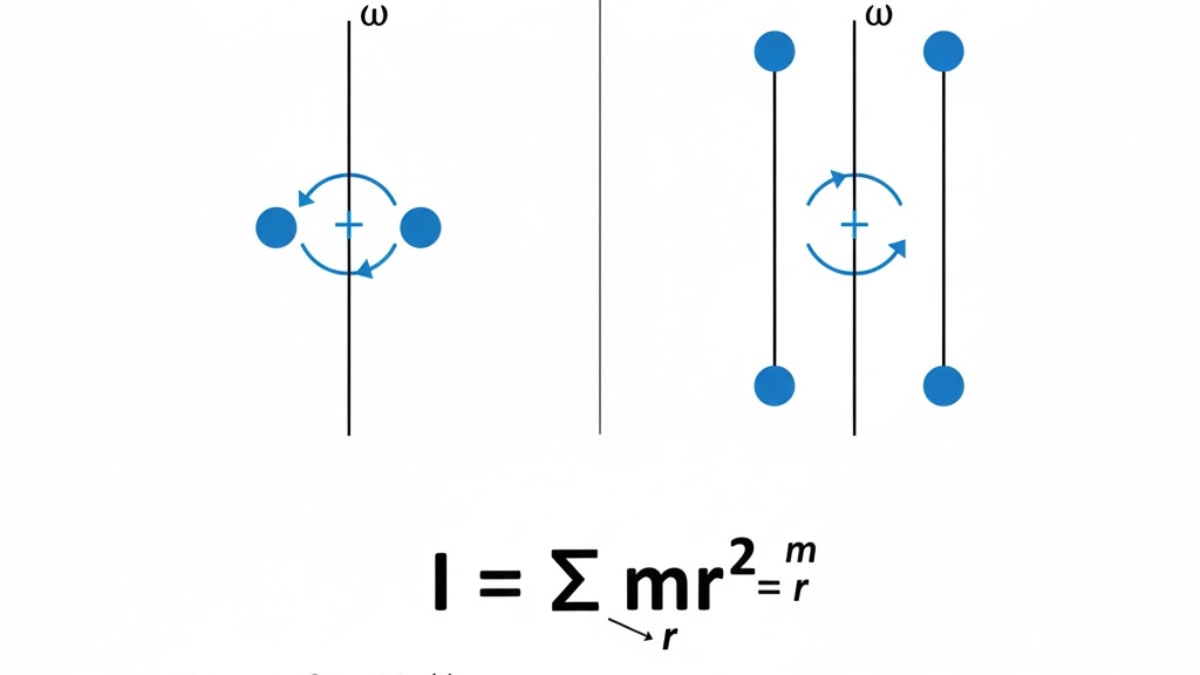
In linear mechanics, mass determines how much a force accelerates an object (F = ma). In rotational mechanics, the equivalent property is the moment of inertia (I), which determines how much a torque accelerates rotation (τ = Iα). Critically, moment of inertia depends not just on an object's mass but on how that mass is distributed relative to the axis of rotation. Mass concentrated far from the axis produces a large moment of inertia (hard to spin up or slow down). Mass concentrated near the axis produces a small moment of inertia (easy to spin). This is why a solid disk and a ring of the same mass have different moments of inertia.
5. Conservation of Angular Momentum
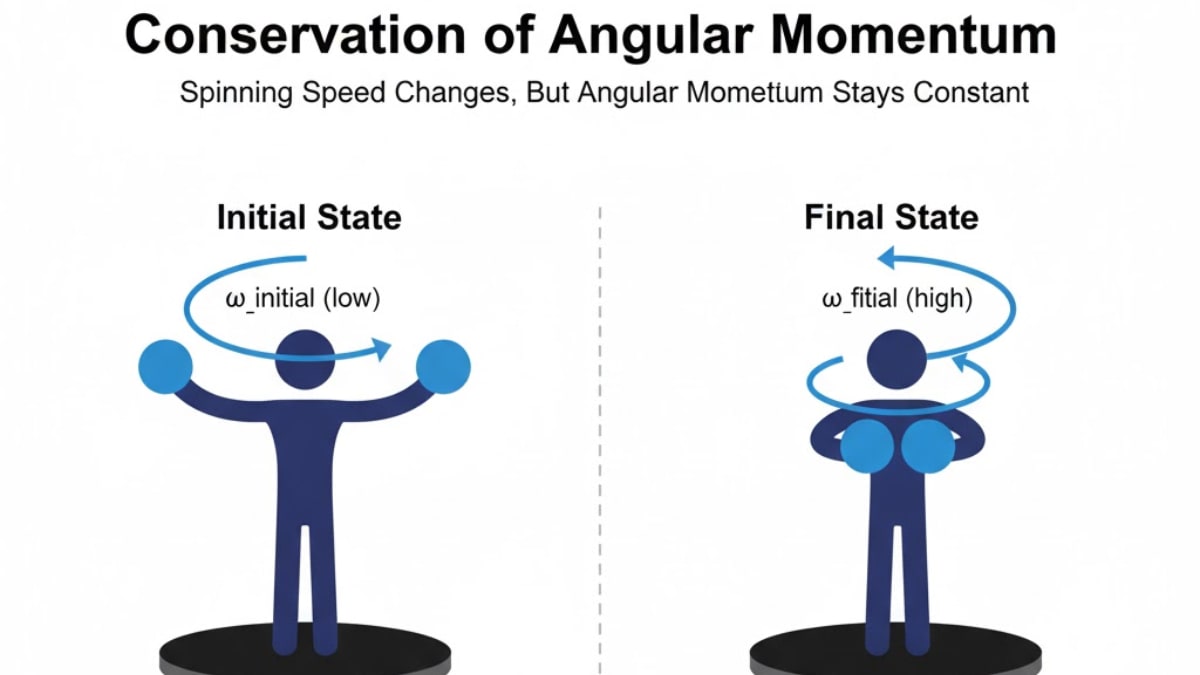
Just as linear momentum is conserved in the absence of external forces, angular momentum (L = Iω) is conserved in the absence of external torques. This principle produces some of nature's most beautiful phenomena. When a figure skater pulls their arms in during a spin, they decrease their moment of inertia. To conserve angular momentum, their angular velocity must increase — they spin faster. When a spinning gas cloud collapses under gravity to form a star, the same principle causes it to spin dramatically faster and flatten into a disk, creating the solar system's structure. Angular momentum conservation is visible everywhere from ballerinas to galaxies.
6. Rolling Motion: Translation and Rotation Combined
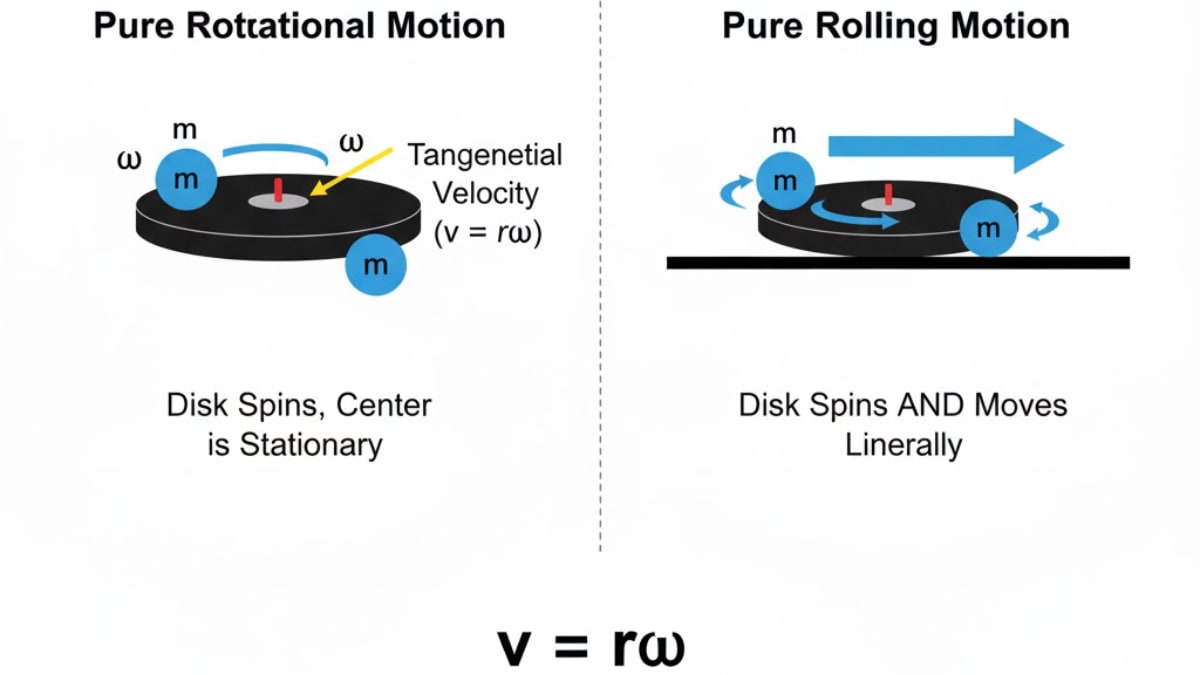
A rolling wheel illustrates how linear and rotational motion combine. The center of the wheel moves forward (translational motion) while the wheel also rotates. For a wheel rolling without slipping, these two motions are linked: the forward velocity of the center equals the product of the angular velocity and the wheel's radius (v = ωr). The point of contact with the ground is instantaneously stationary, while the top of the wheel moves at twice the wheel's center speed. This constraint is what makes rolling more efficient than sliding — rolling replaces kinetic friction with static friction, which does no work and dissipates no energy as heat.
7. Gyroscopes and Precession
A gyroscope — a rapidly spinning wheel — exhibits remarkable resistance to changes in its orientation. This gyroscopic stability arises from the conservation of angular momentum: changing the direction of angular momentum requires an external torque, which creates resistance. Gyroscopes form the basis of navigation systems in aircraft, ships, and spacecraft that must maintain orientation references independently of GPS. The precession of a spinning top — the slow circular wobble of its rotation axis — is another gyroscopic effect that can be precisely analyzed using angular momentum principles.
8. Rotational Kinetic Energy
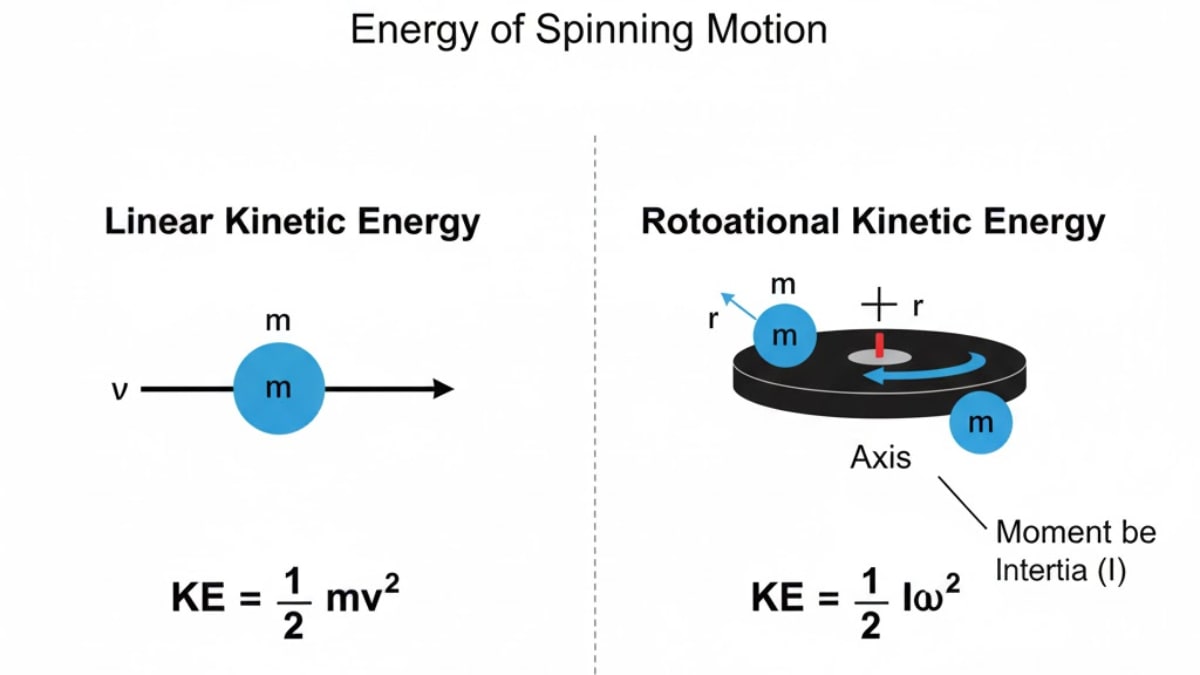
A rotating object has kinetic energy due to its rotation, analogous to the kinetic energy of linear motion. Rotational kinetic energy equals (1/2)Iω² — half the moment of inertia times angular velocity squared. For a rolling object like a ball or cylinder, the total kinetic energy is the sum of translational kinetic energy (1/2mv²) and rotational kinetic energy (1/2Iω²). This is why a hollow cylinder and a solid cylinder of the same mass reach the bottom of a slope at different speeds — the hollow cylinder has more of its mass far from the axis, giving it greater rotational kinetic energy and leaving less energy available for translation.
9. Rotational Motion in Machines and Engineering
Virtually all mechanical power generation and transmission involves rotational motion. Steam turbines, gas turbines, wind turbines, and water turbines convert various forms of energy into rotational motion, which is then transmitted through shafts, gears, and drive trains to do useful work. Gear systems exchange speed for torque (or torque for speed) by combining wheels of different radii. Engine flywheels store rotational kinetic energy to smooth out power pulses. Understanding rotational mechanics is fundamental to mechanical engineering at every scale.
10. From Spinning Tops to Spinning Galaxies
The same physics that governs a child's spinning top also governs the rotation of Earth, the formation of spiral galaxies, the spin of neutron stars (pulsars), and the orbital mechanics of solar systems. Angular momentum is one of the universe's most conserved quantities — once set spinning, things tend to keep spinning for an extraordinarily long time. The Earth's axial tilt, the direction of the seasons, and the regularity of our days and years all trace back to angular momentum deposited when our solar system formed from a collapsing gas cloud 4.6 billion years ago. Rotational motion is not just engineering — it is the universe's fundamental rhythm.
Rotational motion is one of the most ubiquitous and important areas of classical physics — governing everything from the machinery of modern industry to the large-scale structure of the cosmos. Its mathematical elegance — mirroring linear mechanics at every step with rotational counterparts — makes it one of physics' most satisfying frameworks for understanding the physical world. Spin, and the conservation of angular momentum, is literally written into the structure of the universe.
01. Basic Concept of Rotational Motion
02. Torque and Rotational Motion
03. Moment of Inertia
04. Angular velocity and angular acceleration
05. Rotational kinetic energy
06. Rolling motion and rotational motion
07. Conservation of Angular Momentum